Real-Time Intelligent Systems
Intelligent decisions under timing and resource constraints
We design cyber-physical and robotic systems that make useful decisions within explicit timing and resource limits. Our work combines real-time scheduling, executable models of hardware–software interaction, and learning-enabled physical control so that an intelligent system can adapt to uncertainty without giving up predictable behavior.
Student: Tejeswini Jayaramareddy
Collaborator: Hokeun Kim
Selected publications
Value-aware scheduling for intelligent transportation systems
At a busy intersection, a roadside unit may not have enough time or compute capacity to authenticate every connected-vehicle request. Our scheduler prioritizes feasible authentication task graphs by their expected contribution to system utility, increasing the value completed before global deadlines under heavy traffic or limited processor capacity.
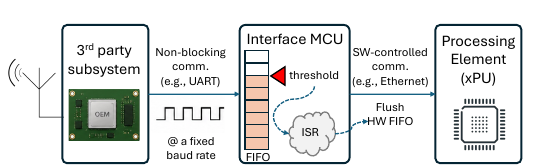
Timing-aware integration of third-party automotive subsystems
Automotive systems often integrate third-party GNSS and other peripherals through finite FIFOs and interrupt-driven microcontroller interfaces. We model the complete hardware-software path and derive safe operating thresholds systematically, because timing choices can affect end-to-end functionality rather than performance alone.
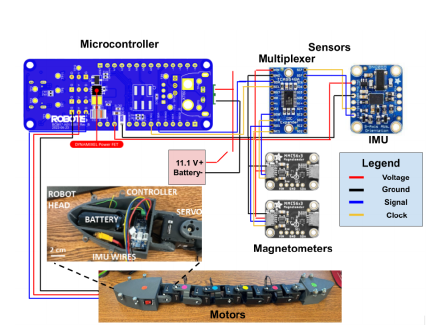
Low-power RL-assisted robotics
Our snake-like robot learns coordinated motions for vertical self-burrowing in granular material, where physical forces are difficult to model. Onboard inertial and magnetic sensing provide feedback for reaching target depths, illustrating how learning and embedded intelligence can enable adaptive physical behavior.
Across these projects, our goal is adaptive intelligence with explicit timing, safety, and resource awareness—from individual embedded devices to distributed sensing and control pipelines.
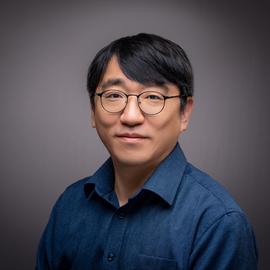
Hoeseok Yang
Associate Professor of Electrical and Computer Engineering
My research interests include hardware/software co-design of AI systems, system security, and embedded system design methodology.